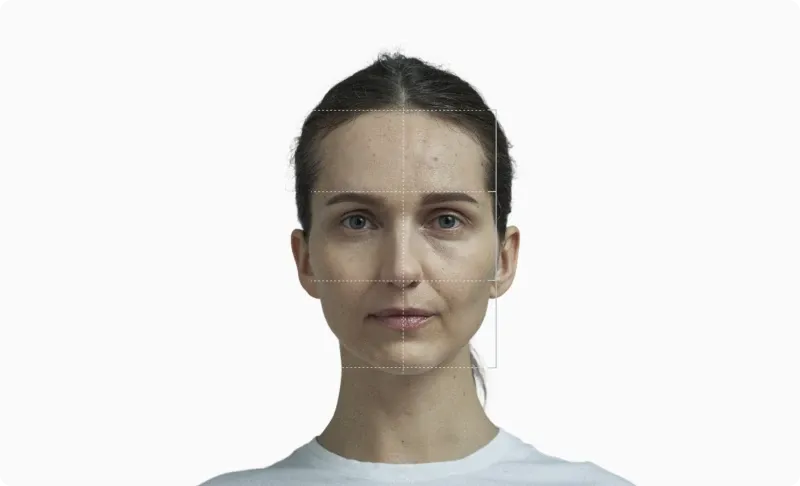
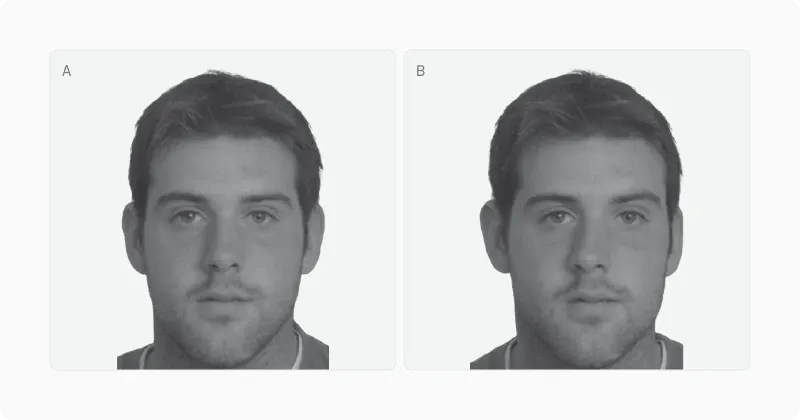
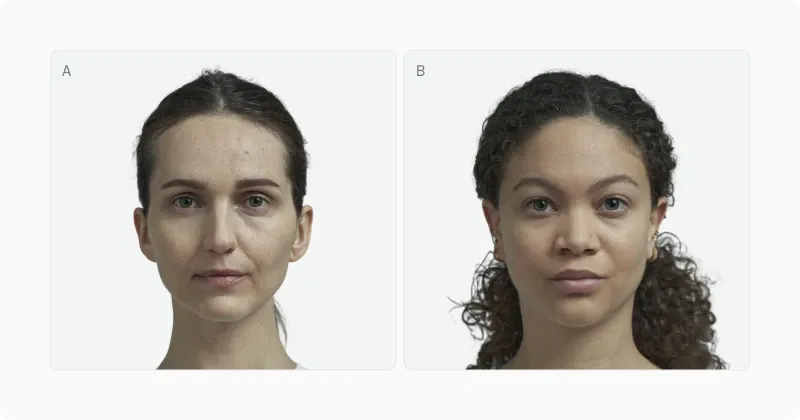
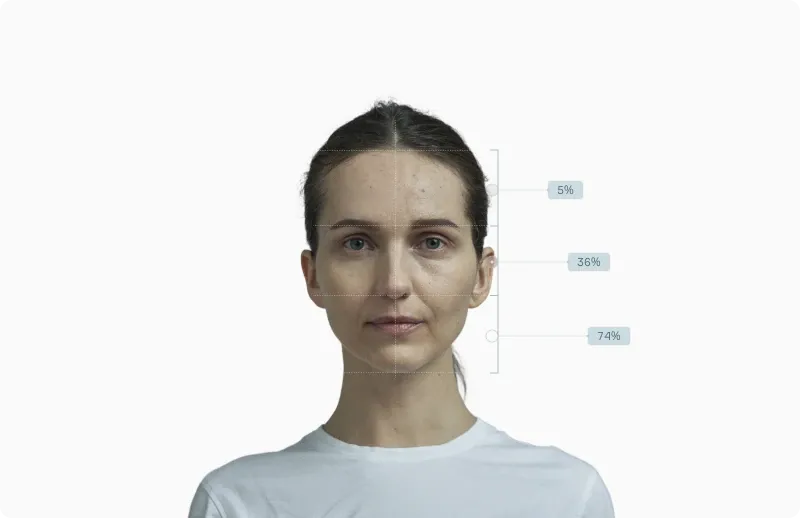
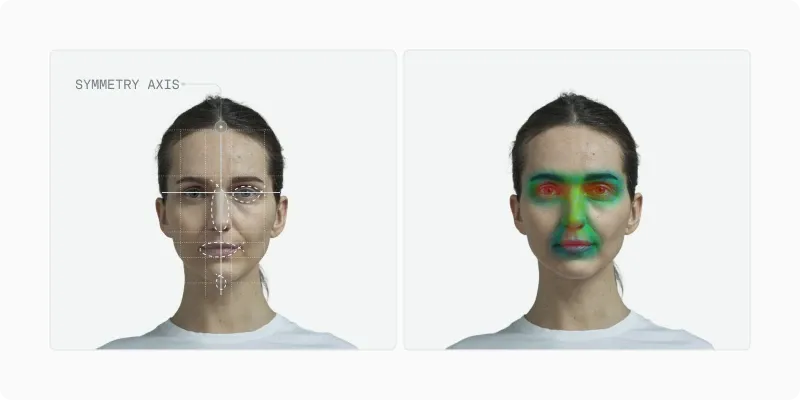
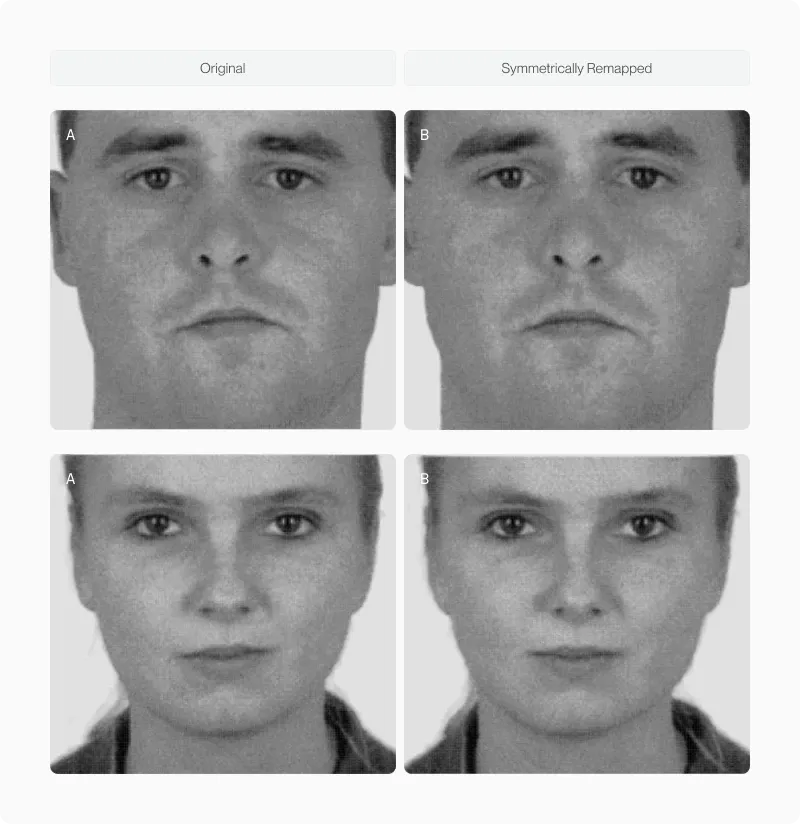
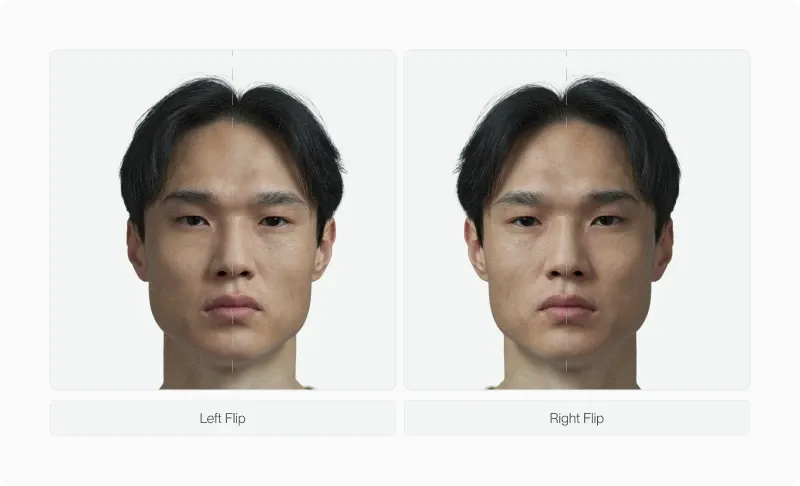
Symmetry doesn’t just improve facial aesthetics; it influences how other people respond to your presence. Research shows that facial symmetry has a wide range of benefits, from signalling evolutionary fitness to social advantages. Below, we summarise some of the best-documented effects of more symmetrical and attractive faces.
The Halo Effect (’What is Beautiful is Good’)
First described by psychologist Edward Thorndike in 1920, the Halo Effect describes how one positive attribute (like attractiveness) leads people to attribute additional favourable qualities to an individual. This effect is well-supported by the scientific literature and has been demonstrated across cultures, age groups, and contexts12. This is sometimes referred to as the “Beauty is Good” phenomenon.
In the context of facial aesthetics, people with more symmetrical, attractive faces are rated as more intelligent, sociable, emotionally stable, responsible, and trustworthy, even when no objective evidence supports these traits13–15. The Halo Effect influences critical life outcomes, as attractive people are more likely to be hired, promoted, and receive higher salaries. In social spheres, they are more likely to be extended invitations to social groups, which can, in turn, increase their social capital and opportunities16. In professional and social contexts alike, beauty acts as a general signal of “goodness.”
The Double-Devil Effect
The inverse of the halo effect, it describes how facial asymmetry or low attractiveness can trigger negative trait attributions, leading people to perceive individuals as less competent, warm, and moral17. Studies confirm this rather cruel effect, and show that faces with visible anomalies, such as scars or palsy, are consistently rated as less competent, less warm, and more dehumanised, regardless of the cause of the anomaly18,19.
It is called The Double Devil Effect because one feature triggers a double (or worse) punishment or judgment. This negative bias can have significant social consequences, increasing the chance of social exclusion and harsher moral judgments. Penalties are sex-asymmetric, as unattractive women often experience harsher penalties than men20.
The Purity Bias
Attractiveness is often equated with moral worth. Moral psychology shows that aesthetic, beautiful faces are perceived as purer and less capable of moral transgression21. In other words, humans attribute moral purity and less capacity for wrongdoing to aesthetic features such as facial symmetry.
This phenomenon occurs because there is an overlap in cognition when it comes to moral character and physical appearance. Work on moral beauty by Klebl and colleagues21 shows that observers spontaneously infer benevolence, honesty, and even “spiritual cleanliness” from attractive faces. The Purity Bias also makes people rate more attractive individuals as less likely to commit moral violations.
The Health Signal
Facial symmetry functions as an indicator of developmental stability, such as resistance to disease, toxins, and stress during growth22. This perspective states that more symmetrical faces reflect fewer developmental perturbations and, by extension, a better underlying health condition overall. Evolutionary perspectives inform us that a robust health status has historically predicted survival and reproductive success, meaning that humans may have evolved a preference for facial symmetry as one of many biological fitness cues.
The Competence Premium
Attractive and symmetrical individuals consistently receive higher competence ratings and better job outcomes20,23. Improving your facial symmetry could help you land a better job or get a pay raise. This Competence Premium is a variation of the halo effect, but with tangible advantages: better hiring prospects, leadership evaluations, and salaries. Benefits are also sex-asymmetric, with attractive women often getting larger boosts.
The Dating Dividend
Facial symmetry predicts greater romantic success, as it increases perceived attractiveness and desirability as a mate. According to experimental studies, faces with increased symmetry are rated as more attractive and as more appealing potential life partners by both men and women1,24. From this research, we can conclude that symmetry directly influences mate choice decisions. More importantly, this effect has been observed across cultures25, so wherever you’re reading this from, improving your facial symmetry will likely enhance how others perceive you.
The Confidence Loop
Your new knowledge on facial symmetry and attractiveness will alter your own behaviour in positive ways if you improve your facial symmetry. This is because believing one looks attractive improves posture, steadies the gaze, and increases social approaches26. This Confidence Loop reinforces itself: feeling attractive makes you act more attractively, which in itself brings about more positive feedback and strengthens self-esteem.
The Disgust Filter
Humans possess a behavioural immune system that evolved to avoid disease cues27. This ancient biological system can trigger avoidance and even disgust responses toward facial irregularities or visible anomalies, often regardless of actual disease risk27,28. The Disgust Filter thus influences intuitive social reactions and aversion at a primal and automatic level.
The Self-Esteem Multiplier
Improved appearance enhances self-esteem, which in turn predicts greater life satisfaction, resilience, and social confidence29. The Self-Esteem Multiplier highlights how increased facial aesthetics (through increased symmetry, for instance) improve self-evaluations or self-confidence. This increase in self-esteem, in turn, is associated with a wide range of positive outcomes, including better mental health, greater resilience, improved interpersonal relationships, and overall higher life satisfaction29–31.
In short: Symmetry operates across biology, psychology, and society. It shapes how others perceive us, how we perceive ourselves, and even how opportunities unfold. The science of beauty is also the science of advantage.