The “Brain Fluency” Effect
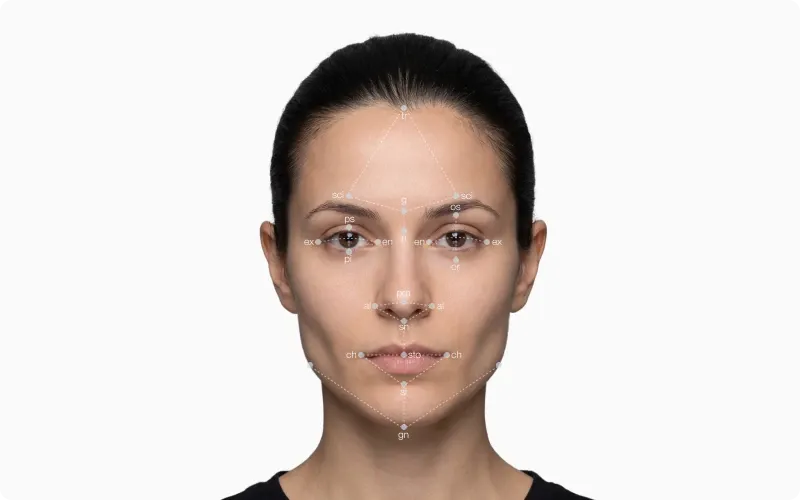
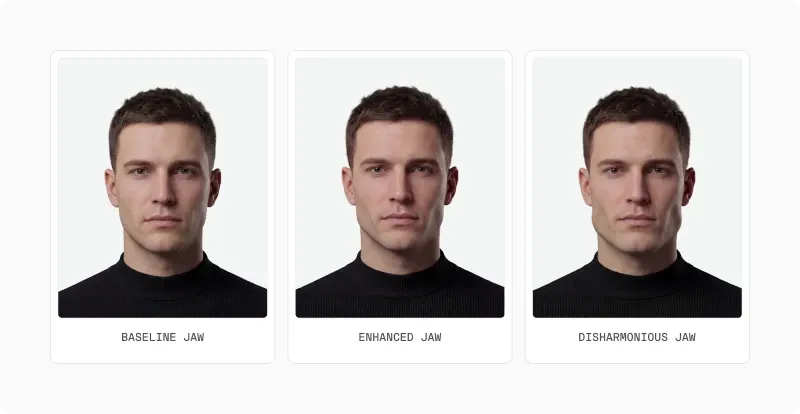
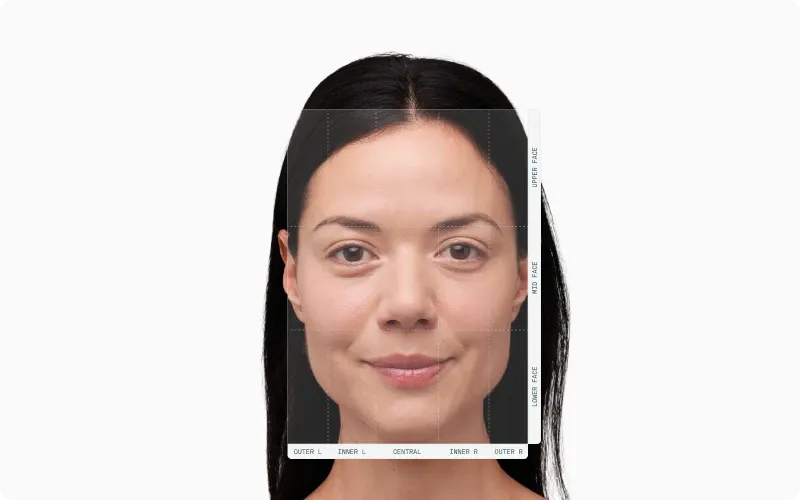
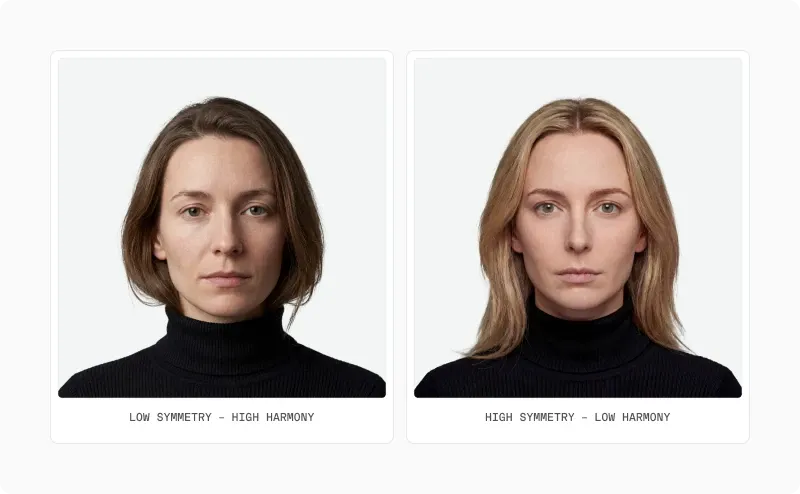
The most direct benefit of facial harmony is a higher baseline level of perceived attractiveness. When features form a balanced, coherent configuration, observers tend to rate the face as more attractive and easier to look at. This is partly because harmonious faces often sit closer to population averages for key proportions, and partly because they avoid extreme asymmetries or disproportionate segments that stand out as “off”.
From a cognitive perspective, harmonious faces are processed more fluently by the visual system. Research on averageness and processing fluency shows that faces closer to the learned prototype elicit faster and smaller neural responses, and people experience this ease of processing as pleasantness6,8. In simple terms, a harmonious face feels easier to take in at a glance, which quietly boosts attractiveness even when observers cannot articulate what changed.
2. The Health and Developmental Stability Signal
Extrapolating from research in other areas of facial attractiveness, it is possible that harmony is connected to how healthy a face appears. Conditions that disrupt growth or endocrine function often leave visible signatures: disproportionate jaw size, unusually long or short midfaces, or marked asymmetries in the eyes, nose or mouth. Faces whose main segments fall within balanced proportional ranges, and whose left and right sides match reasonably well, are less likely to display those extremes and likely perceived as healthier.
Evolutionary accounts argue that proportional, relatively symmetric faces may signal developmental stability, even if the link to objective health is modest in modern environments6. Reviews of proportionality and symmetry converge on a similar point: extreme imbalances are more common in clinical populations, whereas faces near the centre of the distribution tend to be phenotypically typical11,12. When harmony is improved by reducing obvious imbalances, observers often read the result as “healthier” and “more robust”, even if nothing about the person’s actual health has changed.
The most entertaining surface on earth is the human face
German scientist Georg Christoph Lichtenberg
The Halo Effect and the Competence Premium
A harmonious face can benefit strongly from the Halo Effect. Decades of work show that people attribute more intelligence, competence, sociability and emotional stability to attractive faces, with no real objective basis for many of these judgments13,14. Because harmony is essentially the whole-face expression of several attractiveness pillars at once, it tends to amplify this “what is beautiful is good” bias.
This carries over into concrete outcomes. Attractive individuals are more likely to be hired, promoted and paid higher salaries, a pattern we have called the competence premium of facial aesthetics15,16. Harmony does not guarantee success, but by reducing distracting imbalances and making a face read as “put together”, it nudges first impressions in a favourable direction in professional and social settings.
The ‘What Is Ugly Is Bad’ Phenomenon
Just as harmony can trigger a positive halo, noticeable disharmony can trigger its negative mirror image. Work on atypicality and facial anomalies shows that faces with salient deviations, such as marked asymmetries or strong disproportions, are often judged as less warm, less competent and even less moral, a pattern that has been described as the “double-devil effect” or the “ugly is bad” bias17,18.
Research on the behavioural immune system adds a second layer. Strong deviations from typical facial structure can sometimes be processed as potential disease cues, evoking subtle avoidance or even disgust responses despite the absence of any real disease19. In practice, improving harmony generally means moving away from these visually jarring extremes and back toward configurations that observers classify as “normal”. That shift does significantly reduces the risk of unfair social penalties and negative immediate reactions that disharmonious faces can elicit.
The Dating Dividend
Unsurprisingly, facial harmony matters in the romantic domain. Studies on averageness, symmetry and proportionality consistently find that moving faces toward balanced, typical configurations increases attractiveness ratings and perceived desirability as a partner, across both sexes and in multiple cultures5, 7, 20. Since harmony is the “umbrella” under which these cues are integrated, improving overall balance will most likely increased perceived mate value as well.
Harmony does not mean erasing individuality. The most attractive faces are often distinctive in ways linked to youthfulness or sexual dimorphism. Harmonising a face usually means removing obvious clashes between features and bringing everything into a coherent style, not removing every unusual quality. In practice, that often delivers the biggest gain for people who currently have one or two strongly dominant or mismatched features.
The Confidence Loop and Self-esteem Multiplier
There are important psychological benefits associated with facial attractiveness. Feeling that your features “make sense together” and perceptions of attractiveness will impact how you carry yourself.
According to Tesser’s Self-Evaluation Maintenance model21, self-perceived attractiveness is likely to impact how people behave in social scenarios. Especifically, people who perceive themselves as attractive will act in accordance with that evaluation, acting in more confident and attractive ways. This is the start of a confidence loop: improved harmony leads to higher self-rated attractiveness, which leads to more confident behaviour, which elicits more positive feedback, which then reinforces self-esteem.
Social positive feedback and a more robust self-image are thought to positively impact self-esteem, which is a strong predictor of many other outcomes. Longitudinal work on self-esteem and life outcomes suggests that higher self-esteem is associated with better mental health, greater resilience and higher life satisfaction22.