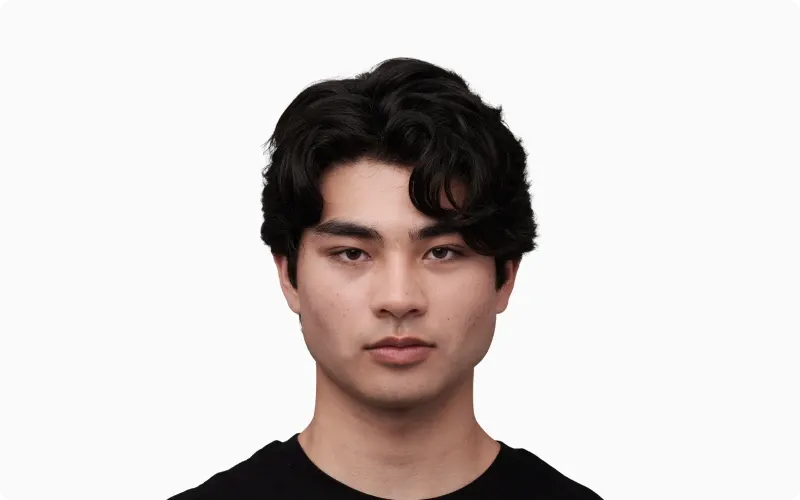
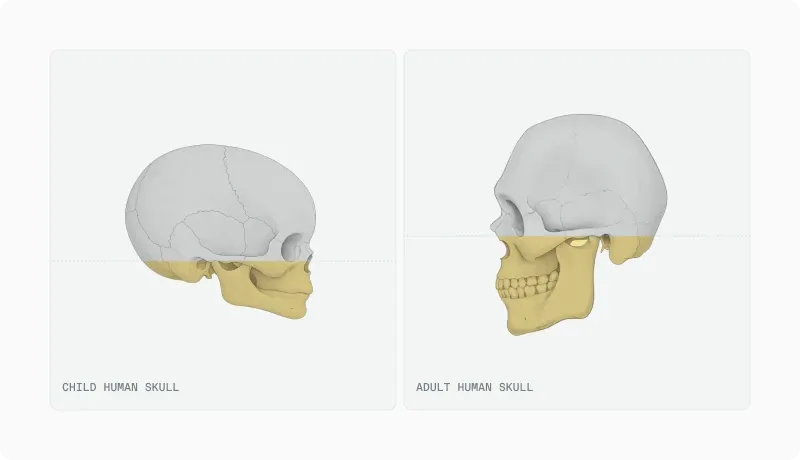
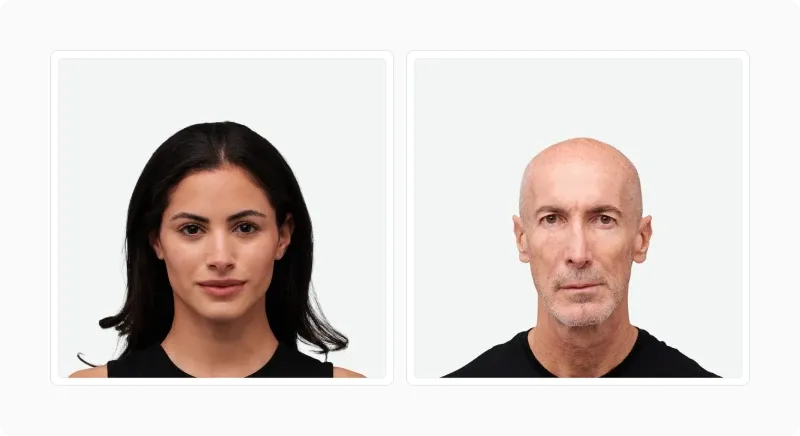
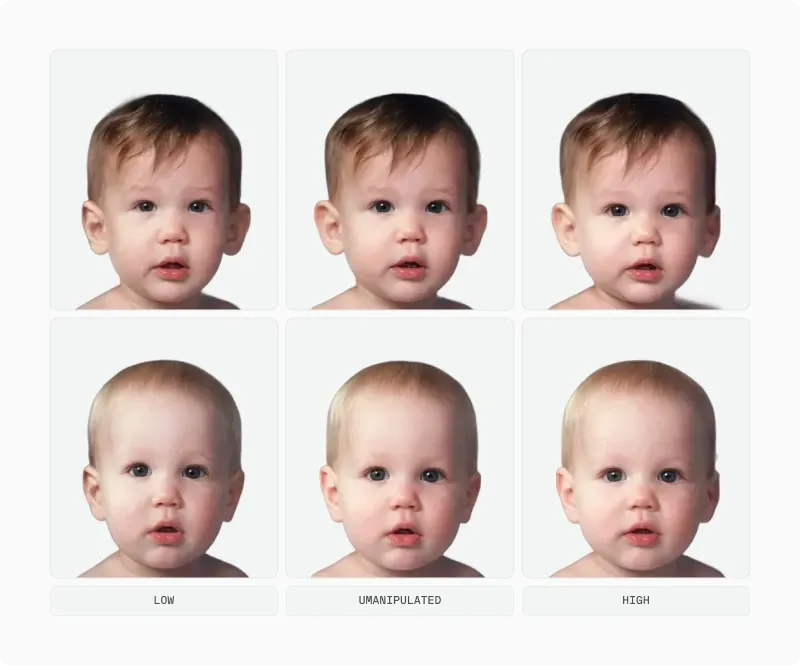
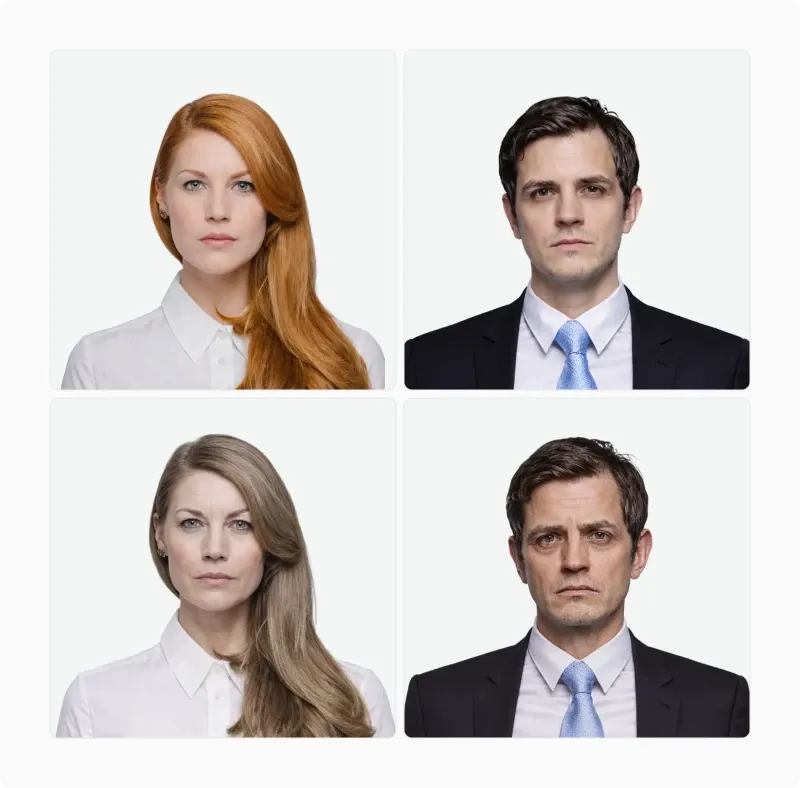
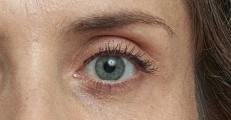
We’ve mentioned non-neotenous traits that contribute to youthfulness: smooth, clear skin, white sclera, and facial contrast. All of these are relevant for female beauty (while only the first two matter for male beauty) and reinforce this femininity dividend.
In African samples, younger-looking women with more homogeneous skin and lower facial adiposity are judged more attractive, suggesting that youthfulness, skin quality, and slimness contribute to female beauty ideals33. Cross-cultural work on facial contrast shows that higher contrast around the eyes and lips makes women look more feminine, youthful, and attractive in multiple ethnic groups3.
Similarly, whiter sclera makes female faces look younger, healthier, and more attractive1. Together, these findings support a consistent pattern: for women, neoteny and youth cues contribute to facial femininity, creating a powerful composite signal of health, fertility, and softness.
Neoteny and Masculinity
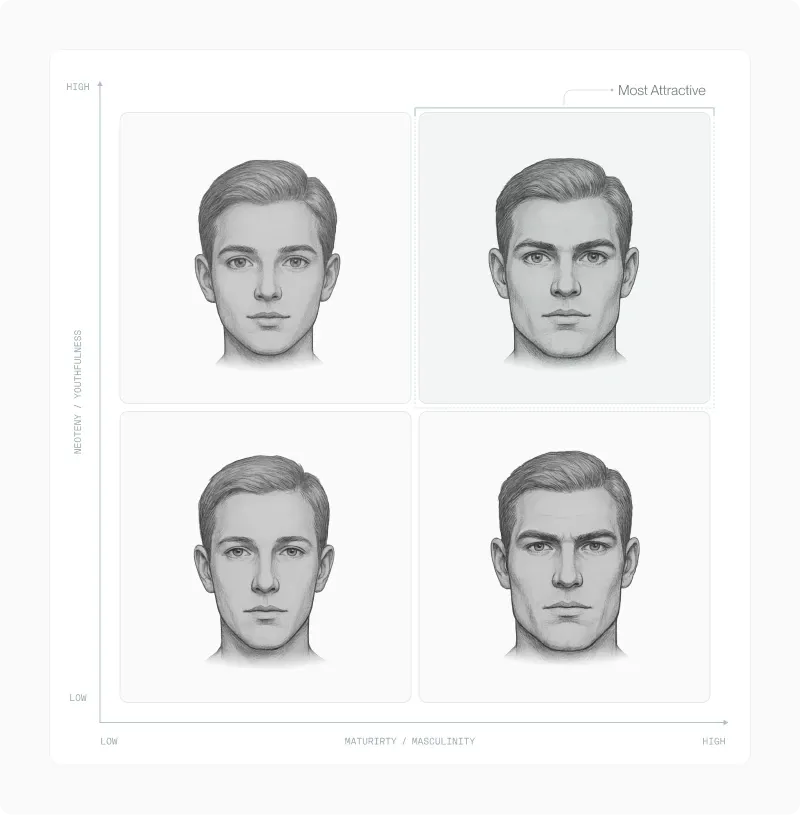
As we have repeated throughout this article, youthfulness and neoteny interact very differently with masculinity than with femininity. Neotenous cues signal warmth, trustworthiness, and low threat, traits that can be advantageous in cooperative or caregiving contexts or for long-term pair bonding. Studies show that youthful-looking men are judged as more approachable and socially warm30, and older-looking male faces receive lower ratings of fitness and vitality even when age is controlled32.
However, these very same cues can diminish perceived dominance, strength, and authority. These are all qualities tied to highly masculine faces (pronounced brow ridge, jaw width; see Sexual Dimorphism). When youthful cues become too strong, male faces may be read as less competent or less suited for leadership roles, reflecting classic “babyface” stereotypes34.
Non-neotenous youthful cues, that is, clear skin and bright sclera, reap all of the benefits of looking younger without impacting perceptions of masculinity or dominance1,3. With regard to neotenous or infant-like features, moderation is key. As we’ve mentioned, they can signal warmth and other desirable mate traits, and extremely mature and masculine faces are not actually the most attractive (see Sexual Dimorphism). As a rule of thumb, it’s likely worth it to enhance youthful features (non-neotenous) and to find some balance between mature and neotenous facial traits.
Neoteny and Perceived Age
Broadly, neoteny contributes to a younger look, and enhancing neotenous features will change perceptions of age. However, at least one study manipulating baby-schema traits found that attractiveness increased even though perceived age did not change35. In simple terms, raters found women with neotenous characteristics more beautiful without rating them as younger. It’s worth noting that this study only used a narrow adult range (18-25), but it does suggest that some neotenous cues operate independently of age perception. This means that neoteny is not solely attractive because it makes people look younger; there is something else to it.
When considering larger and more varied samples, younger age always predicts attractiveness. A very recent study by Singh and colleagues in 2024 found a negative correlation between perceived age and attractiveness across 2870 female faces36.
Youthfulness, Neoteny and Health
Research consistently demonstrates strong connections between youthful facial features, neoteny, and perceptions of health. Studies reveal that neotenous features (e.g., large eyes, small noses, and small chins) significantly predict attractiveness ratings. This effect can be largely (but not completely) attributed to the fact that perceived age and attractiveness have a negative correlation, as younger-looking faces are consistently rated as more attractive36.
Perceived age is critical because it serves as a biological marker of health and well-being. Research shows that age indicators, such as wrinkles, reduced facial contrast, and duller sclera, are associated with poorer health outcomes and higher mortality risk. A large clinical twin study of over 1800 people had independent observers estimate ages based on facial photos. Results showed that those who looked older than their actual age had higher mortality rates and worse physical and cognitive function, even when controlling for chronological age37. What this means is that how old you look is generally related to your overall health, so a 30-year-old who looks 20 is likely closer to 20 in terms of biological age.
It should come as no surprise, then, that youthful and neotenous features are treated as health signals. Younger-looking faces are not only rated as more attractive but also biologically fitter, more energetic, and more physically capable31.
In summary, neotenous and youthful characteristics are strongly linked to perceptions of better health and vitality, which can bring advantages beyond looking better (see Benefits of Youthfulness).
These findings are, of course, consistent with evolutionary theories, which argue that neotenous facial attractiveness provides potential mates with information about phenotypic and genetic quality. The preference for youthful features may have evolved because such characteristics signal extended fertility periods, superior constitution, and longevity. This creates a feedback loop where youthful appearance signals health, which in turn enhances attractiveness and social advantages throughout the lifespan.
Neoteny Across Cultures
During his time as a visiting scholar in anthropology at Cornell University, Doug Jones published one of the most important papers in the field of neoteny and beauty2. His cross-cultural work is now taken as strong evidence that preferences for neoteny are largely cross-cultural, highly influenced by biological drivers.
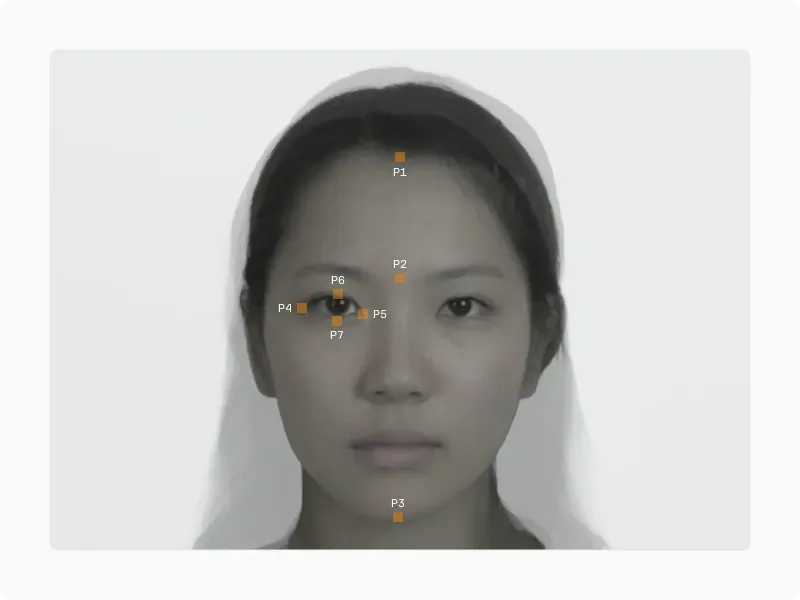
In a series of three studies, Jones looked at five very different populations: US Americans, Brazilians, Russians, and two relatively isolated hunter-gatherer groups, the Ache of Paraguay and the Hiwi of Venezuela. Jones measured basic facial proportions (eye size, nose length, lip fullness) and used them to estimate how young a face looked based on its features. Faces that “read” as younger than their actual age were classified as more neotenous.